Quick answer: For ordinary two-burner car camping, start comparing well-reviewed models around 10,000–20,000 BTU per burner. Consider a tested 10,000-BTU model when portability, fuel use, and price matter more than quick boiling; consider the 20,000-BTU Everest 2X when wind resistance and faster boiling matter. This is a shopping range drawn from specific tested models, not a minimum every stove must meet. Larger 30,000-BTU cooking systems can make sense for their cooking-station features, but their rating alone does not guarantee faster meals.
OutdoorGearLab’s camping-stove comparison supplies the test evidence behind that starting point. It describes the Coleman Cascade Classic and ODSD two-burner models as portable, fuel-conserving alternatives with two 10,000-BTU burners, while favoring the Everest 2X’s 20,000-BTU burners, simmer control, and wind resistance. These are its findings; we have not tested these stoves ourselves.
Featured image credit: Photo: Dinnertime with my BioLite cookstove; Pear Lake, Sequoia National Park by oliveoligarchy, https://www.flickr.com/photos/14818348@N00/8035236101; https://creativecommons.org/licenses/by/2.0/. Resized and padded. Illustrative stock photo; no product testing is implied.
Choose the rating around the meals you cook
A burner rating is useful once you know the task. Someone making coffee and a small skillet breakfast has a different shopping priority from someone setting up a freestanding cooking station for several dishes. Use the examples below to build a shortlist, then check the exact model and cookware before buying.
| Your main priority | A practical starting point | The evidence to check |
|---|---|---|
| Simple meals, manageable packing, and restrained fuel use | Compare tested models around 10,000 BTU per burner, such as the Coleman Cascade Classic or ODSD two-burner stove | GearLab describes them as portable and fuel-conserving, with slower boiling than higher-output options; check its exact model results |
| Quicker water boiling and cooking in breezy campsites | Put the 20,000-BTU-per-burner Everest 2X on the shortlist | Its favorable wind and boil results come from tests, not just the rating |
| A freestanding cooking station with side shelves and compatible cooking accessories | Consider a system such as the 30,000-BTU-per-burner Camp Chef Pro 14 | Its manufacturer lists folding legs, side shelves, and compatibility with its 14-inch accessories; confirm the accessories and cookware you need |
| Sauces, rice, eggs, or other gentle cooking | Prioritize tested low-flame control after choosing the layout | Maximum BTUs do not state the lowest controllable heat |
The first two rows are based on GearLab’s reported comparisons; the third uses Camp Chef’s Pro 14 specifications. The range is deliberately a place to start shopping. A poorly protected 10,000-BTU burner and a well-designed burner with the same rating can perform very differently, and no number guarantees that your particular pans fit safely.
For a concrete choice, imagine that you cook oatmeal, make hot drinks, and carry a modest pan for two people. If a slower boil is acceptable, the tested 10,000-BTU examples are reasonable candidates to compare on pack size and fuel use. If waiting for water in a breezy campsite is your main frustration, the Everest’s measured wind performance is a stronger reason to shortlist it than simply buying the highest available rating.
For a larger cooking station, work in the other direction: choose the layout and approved accessories that suit your menu, then compare output. The Pro 14’s legs and shelves may be useful even if its higher maximum rating is not your deciding factor. Do not buy a 30,000-BTU system solely because you assume it will boil every pot faster.
What the independent boil tests actually show
GearLab reports boiling one liter of water starting at 58°F at an elevation of 5,000 feet. It compares calm conditions with a steady 2–4 mph airflow from a fan. Those conditions make its side-by-side results useful, but they do not reproduce changing outdoor gusts, every pot, or every campsite.
| Model named in GearLab’s test | No-wind boil time | With 2–4 mph airflow |
|---|---|---|
| Camp Chef Everest 2X | 3.4 minutes | 3.8 minutes |
| Camp Chef Pro 60X (Pro 14), as labeled by GearLab | 3.9 minutes | 5.7 minutes |
Source: GearLab’s “Time to Boil 1 Liter of Water” table. These are the reviewer’s reported results for the models it tested, not our measurements or guaranteed times for current units. Check model revisions before transferring a review’s findings to a product on sale today.
The useful conclusion is narrower than “more BTUs are worse.” In this comparison, the lower-rated Everest finished sooner, and the difference grew under the test’s airflow. Burner position, wind protection, and the rest of the stove design matter alongside maximum output. Use actual model tests to judge speed, and use the manual to judge safe setup.
Read per-burner figures before combined totals
Camp Chef lists the Everest 2X with two 20,000-BTU burners. It lists the Pro 14 with two 30,000-BTU burners. Their calculated combined totals are 40,000 and 60,000 respectively, but neither total is the rating available from one burner to one pot.
If you are heating one kettle, compare the individual burner ratings. If you cook two dishes at once, compare burner count, spacing, and cookware guidance as well. A stove advertised only with a combined figure needs further checking: do not assume an even split unless the maker confirms it.
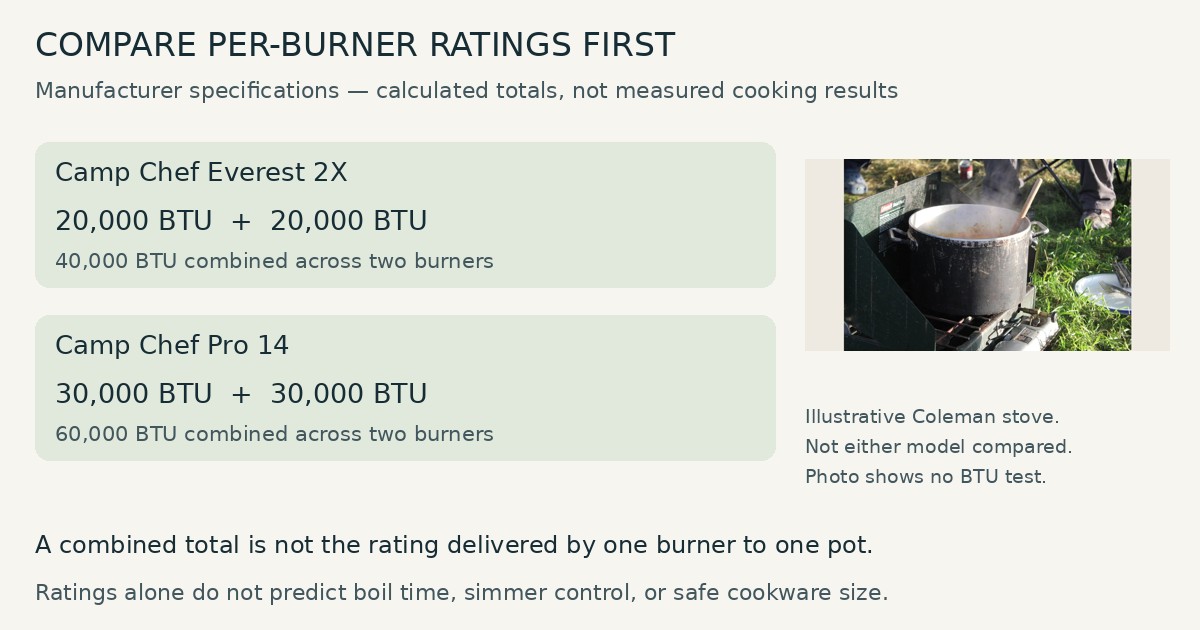
Comparison graphic: Pack and Pocket, using Camp Chef Everest 2X and Pro 14 published specifications. Photo: IMG_1235 Coleman Dual Fuel 2-Burner Stove by Tim Sheerman-Chase, https://www.flickr.com/photos/68932647@N00/7502032366; https://creativecommons.org/licenses/by/2.0/. Photograph resized and combined with original annotations. The photograph shows a different liquid-fuel stove; no product or boil-time testing is implied.
A British thermal unit, or Btu, measures heat energy. The U.S. Energy Information Administration defines one Btu as the heat needed to raise one pound of water by 1°F. A fuel-content figure expressed in Btu per gallon is different from a burner’s advertised output rating. It does not tell you how quickly a stove will heat your meal or how long your fuel container will last.
Check simmering, cookware, and fuel separately
For gentle cooking, look for a review that actually evaluates simmer control. GearLab reports favorable simmering performance for the Everest 2X, but that does not turn every 20,000-BTU burner into the same stove. Check how the exact controls work, and follow the manufacturer’s instructions for adjustment and lighting.
For a wide pan or two pots, verify the permitted cookware and the space between burners. A product’s total cooking-surface area is not automatically its maximum safe pot diameter. Take your intended cookware dimensions to the comparison rather than discovering at camp that the two pans cannot sit correctly together.
Fuel compatibility also needs its own check. Use only the fuel, regulator, hose, and connection approved for your model. A high rating is not permission to attach a different container or improvise an adapter. For meal ideas after choosing a suitable setup, see our camping-stove meal guide.
Altitude and weather change what you should expect
Water boils at a lower temperature at higher elevations. The National Center for Home Food Preservation lists 212°F at sea level, 204°F at 4,000 feet, and 197°F at 8,000 feet. Its elevation table describes boiling temperature, not a required stove rating. A rolling boil at altitude does not mean the water is as hot as a rolling boil at sea level.
When using a stove review, compare its water quantity, starting temperature, vessel, elevation, and wind conditions with your plans. Treat published times as comparison evidence rather than a schedule for dinner. For recipes, follow any high-altitude cooking guidance instead of trying to compensate merely by buying a larger burner.
Use the stove outdoors in an open-air cooking area and follow its specified clearances and wind-protection instructions. The American Red Cross’s carbon-monoxide guidance warns against using gas or charcoal grills in homes, garages, vehicles, tents, or semi-enclosed spaces and identifies propane-burning appliances as possible carbon-monoxide sources. Although that warning names grills, keeping a fuel-burning camping stove out of enclosed spaces is the conservative practice; the exact stove manual still controls its setup.
Make the final choice with three questions
- What matters most for your meals? Start near the tested 10,000-BTU examples for portable basic cooking, or compare the tested 20,000-BTU Everest when quick boiling in wind matters more. Choose a larger cooking system for useful layout and accessory features.
- Does evidence support that exact model? Check measured boil and simmer results, the test conditions, and whether the version being sold matches the reviewed one.
- Will your equipment fit safely? Confirm cookware, fuel, setup, and storage requirements in the manual before buying.
The useful target is a capable stove for your menu, not a universal minimum. The 10,000–20,000-BTU-per-burner starting range helps narrow ordinary car-camping choices; model-specific tests and compatibility checks make the final decision.