A propane camping stove can suit car camping when convenient fuel and familiar cooking matter more than minimum pack weight. A stove designed for a 1-pound cylinder keeps the setup compact; a compatible hose-and-tank system may suit a longer stay. Choose by the stove maker’s approved fuel arrangement, pot support and cookware limits, then test the setup outdoors before leaving. Check the maker’s operating conditions for cold trips; this guide does not establish a minimum operating temperature for your stove.
Never use portable fuel-burning camping equipment inside a home, garage, vehicle, or tent, Poison Control warns. Carbon monoxide is colorless and odorless. Propane is stored under pressure as a liquid and vaporizes as pressure is released, according to the U.S. Department of Energy’s Alternative Fuels Data Center; that basic property does not establish a particular stove’s cold-weather performance.
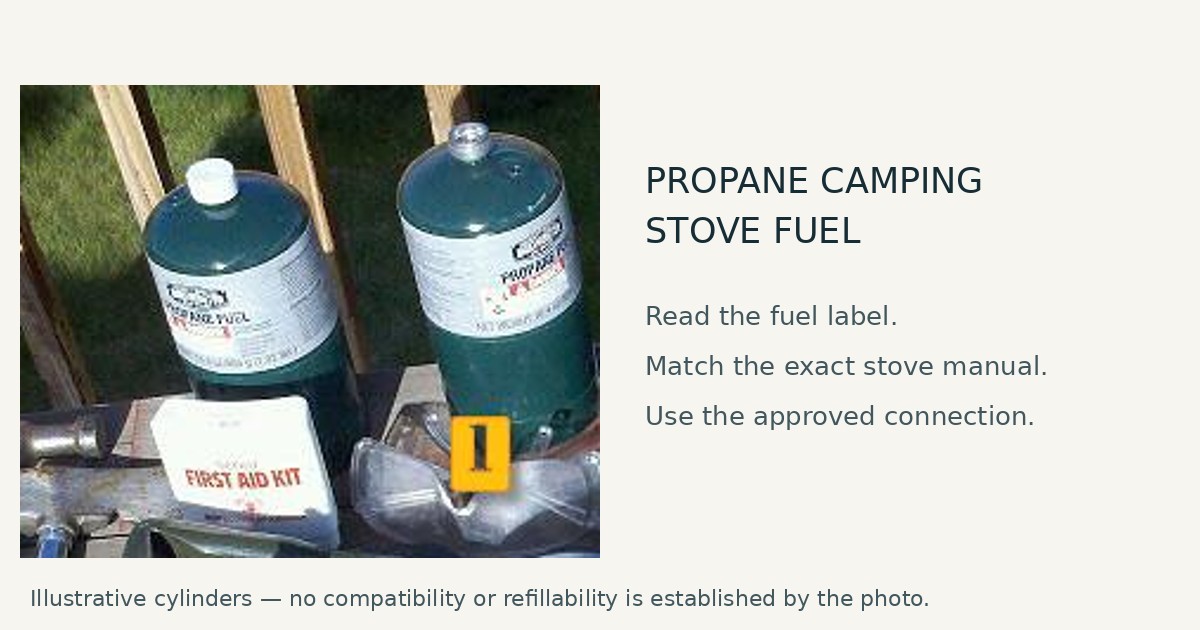
Fuel-identification graphic: Pack and Pocket. Photo: Details 3 by jazonp, https://www.flickr.com/photos/53068176@N00/5701505643; https://creativecommons.org/licenses/by/2.0/. Cropped and combined with original annotations. Illustrative propane cylinders; no compatibility, refillability or product testing is established.
TL;DR: Use only the fuel setup your stove approves. Test it outdoors before the trip, cook outdoors, and bring a no-cook backup for cold or wet weather.
Quick answer: choose the fuel format around the trip
Start with the stove you already own—or the one you are considering—then buy only the fuel format it explicitly approves. Do not assume that an adapter makes a stove compatible with every propane cylinder or tank. A cylinder label tells you what fuel is inside; it does not verify that its connection, pressure regulation, or orientation is suitable for a stove. The U.S. Department of Energy’s Alternative Fuels Data Center explains that propane is stored as a pressurized liquid and vaporizes as pressure is released, but the appliance maker’s instructions determine the approved setup.
| If your trip looks like this | A practical propane starting point | What to verify before leaving |
|---|---|---|
| One or two people, short car-camping trip | A stove designed to take a 1-pound disposable cylinder directly | The cylinder connection, fuel type, and whether the cylinder can support the stove as designed |
| Several meals at a drive-in campsite | A stove approved for a remote refillable tank, hose, and regulator | The exact hose/regulator assembly, tank orientation, and safe hose routing |
| Cold, wet, or windy forecast | The setup you can test outdoors before the trip, plus a no-cook backup | Your stove manual’s operating instructions and a protected, level cooking site |
| Walk-in or weight-sensitive camping | Reconsider whether propane is the right fuel system for the carry | Total fuel-system weight, bulk, and the rules for your destination and transport |
Check the stove details before buying
Use the manufacturer’s manual and product specifications—not a generic comparison chart—to check:
- Which fuel, cylinder, hose, regulator, and connection are approved, including any required tank position.
- The stated pot-support and cookware size or weight limits. If the maker does not publish a limit, ask rather than guessing from burner size.
- Whether burner control suits your meals, from a low simmer to the higher heat needed for boiling.
- Listed operating conditions, wind guidance, setup dimensions, and stove weight. Include the approved hose and regulator weight when comparing what you will carry.
The main tradeoff: convenient cylinders versus a larger fuel reserve
A disposable cylinder keeps the connection simple when the stove is designed for that format. Its limitation is capacity: multiple meals for several people can mean carrying several cylinders.
A refillable tank can be practical for a fixed campsite because it holds more fuel. But it creates a more involved system: a compatible hose, regulator where required, a stable place for the tank, and safe routing away from hot cookware and foot traffic. It is not automatically an upgrade for every stove.
Write down your meals before choosing a fuel reserve; trip length alone cannot tell you what your stove will use. This guide to easy camping-stove meals and campsite techniques can help you estimate how much cooking you plan to do. For a walk-in site, factor the stove, fuel, cookware, and water into the capacity you need from your pack.
Compatibility: treat the connection as a system
Start with the stove manual. It outranks retailer listings, social posts, and generic adapter descriptions. Confirm all of these parts of the fuel setup together:
- Fuel type: The appliance must be intended for propane—not merely a similarly shaped canister or a different gas blend.
- Connection: Match the connection specified by the stove manufacturer. Do not force threads or use a part that starts crookedly.
- Hose and regulator: Use the exact configuration approved for that stove. Some stoves are designed for a direct cylinder; others need a remote hose or regulator.
- Cylinder or tank position: Keep the fuel container in the position required by the instructions. Do not improvise an inverted, suspended, or unsupported setup.
- Use case: A hose meant for a grill or another appliance is not proof that it is appropriate for a camping stove.
Use an adapter only when the stove manufacturer explicitly approves that setup. It does not remove pressure, regulator, clearance, or stability requirements. If approval is unclear, use the designed connection or choose another stove.
For a concrete buying check, GSI’s Selkirk 540+ listing identifies propane as its fuel and includes a regulator. Those details do not by themselves identify every compatible cylinder, connector or hose. Compare the exact product instructions with the parts you plan to buy, as the worksheet below shows; ask GSI about anything missing. Its warning also requires outdoor use, keeping the stove and cylinder away from other heat sources, and unobstructed airflow.
Before each trip, inspect the threads, seals, hose fittings, and cylinder or tank exterior. Do not connect equipment that looks damaged, corroded, badly dented, or altered. Attach fuel outdoors and keep ignition sources away. If you suspect a leak or smell gas, stop, move away, and follow the appliance and propane-safety instructions. Never check for a leak with a flame. Camp Chef’s cooking-system FAQ describes a soap-and-water check along hoses and valves and says to let its units cool fully before storage. Use your own model’s complete instructions for the connection, leak check and shutdown sequence; that FAQ does not authorize another stove’s parts or procedures.
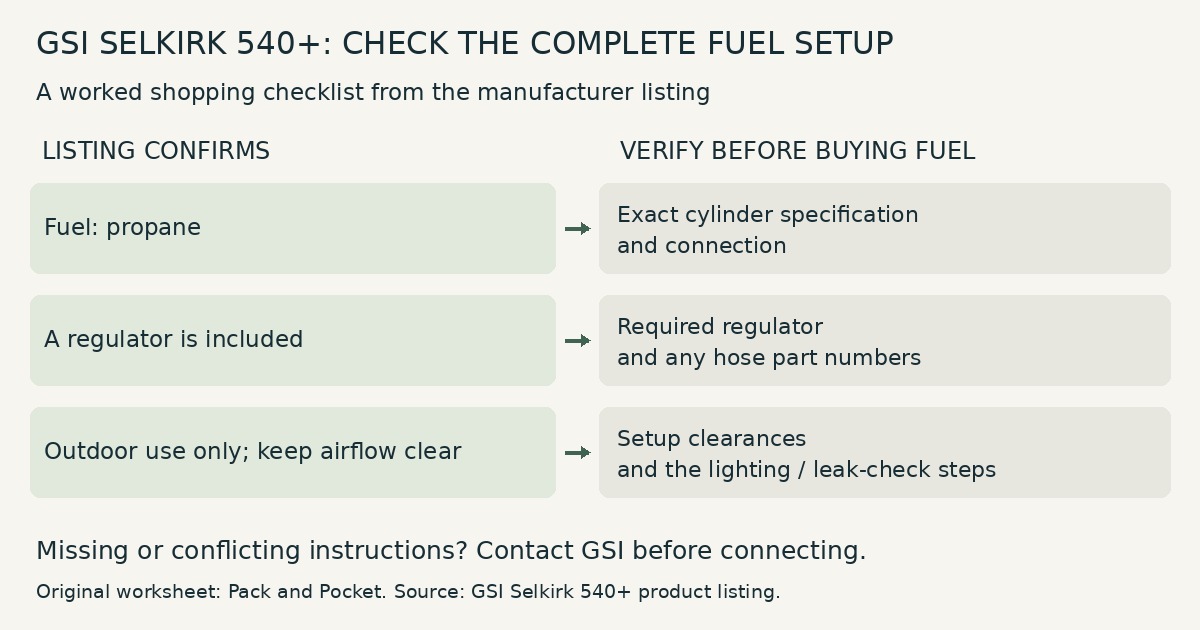
Original verification worksheet by Pack and Pocket, CC BY 4.0 (https://creativecommons.org/licenses/by/4.0/). Based on the GSI Selkirk 540+ listing; no photograph, manufacturer diagram, or product testing is implied. It identifies questions to resolve, not an approved connection.
Cold weather: what propane can—and cannot—tell you
Propane supplier Ferrellgas explains that extreme cold can affect propane delivery and that frost or ice can form on cylinders, regulators and lines. Ice around a regulator is not proof that the fuel itself has frozen. Its guidance concerns propane systems generally; it does not test camping stoves or establish an operating cutoff for any particular model.
The practical lesson is to plan around the whole approved fuel system, rather than assume a cylinder will perform identically in every forecast. Ferrellgas advises keeping relevant vents and components clear of snow and ice, positioning portable tanks correctly, and contacting a qualified provider if a system is not working properly. It specifically advises against attempts to de-ice tanks or systems with flames or water. Follow your stove and container instructions for their particular arrangement; do not change the cylinder orientation to chase a stronger flame.
For planning, use the maker’s published operating conditions for the exact model and connection. If cold conditions are outside those instructions—or the maker gives no cold-weather guidance—contact the manufacturer rather than assuming it will work. Do not choose or improvise an adapter to compensate for poor performance.
Before leaving, test your exact stove and approved fuel connection outdoors. The National Park Service recommends practicing with a camp stove before a trip if it is new, difficult to start, or may have broken parts. This check can catch an unfamiliar setup, but a mild-weather test does not guarantee performance in colder conditions.
Bring food that can be eaten cold or prepared with little or no cooking, especially for arrival night or a weather delay. If performance is weak, switch to that backup; turn the appliance off, let it cool, and follow the manual. Never warm a cylinder with an open flame, defeat a safety feature, or alter the fuel path. A wind-protected outdoor cooking spot, when allowed by the manual and with airflow unobstructed, may help reduce wind exposure, but it cannot correct a fuel-compatibility or equipment problem.
A safe outdoor setup, step by step
Use the manual for your particular stove as the final checklist, then apply these broad habits every time:
- Pick the surface first. Set the stove on a level, firm, noncombustible surface with room to keep fuel, food packaging, chairs, and traffic away from the burner area.
- Keep it fully outdoors. Open tent doors, a vehicle hatch, or a cabin window do not turn an enclosed space into an outdoor kitchen. Carbon monoxide is colorless and odorless, so portable fuel-burning camping equipment belongs outside—not in a home, garage, vehicle, or tent, as Poison Control warns.
- Connect fuel with the controls off. Follow the manufacturer sequence. Check that the stove is stable before lighting it.
- Light deliberately. Keep your face, hands, loose sleeves, and flammable items clear. Adjust the flame only after ignition is stable.
- Cook with the pot centered and attended. Apply the general stove-safety principle in Ready.gov’s home-fire guidance: turn the stove off before stepping away, even briefly. Oversize cookware can make a compact stove unstable or trap too much heat around parts of the appliance, so use cookware within the stove’s stated limits.
- Shut down and cool before packing. Turn off the appliance as instructed, let it cool completely, disconnect only as the manual directs, and protect the fuel connection from damage in transit.
For transport and storage, follow local rules and the cylinder/tank instructions. Protect the container from damage, keep it away from ignition sources, and do not treat a loose cylinder in a vehicle as ordinary luggage. The fuel-container label and your stove manual should decide for the specific product you carry.
Troubleshooting without improvising
The stove will not light
First turn the control off. Confirm that you are using the approved fuel format, that the cylinder or tank is connected according to the manual, and that any valve is in the required position. If the stove has a piezo igniter, follow the manual’s procedure for checking it; do not keep releasing gas while repeatedly clicking an igniter.
The flame is weak or uneven
Turn the stove off and let it cool. Check for wind, a poorly seated connection, or a fuel supply issue using the manual’s steps. In cold conditions, switch to a simpler meal plan rather than trying to heat, puncture, refill, invert, or otherwise alter a disposable cylinder.
You smell gas or suspect a leak
Do not light the stove, operate electrical switches nearby, or use a flame to investigate. Move people away, avoid ignition sources, and follow the emergency directions on the cylinder, tank, and appliance documentation. Do not resume cooking until the issue is resolved according to those instructions.
Make the final choice
A propane camping stove works best when the trip, fuel format, and appliance match. A direct-connect 1-pound cylinder can suit simple car camping; an approved hose-and-tank setup can suit a stationary group campsite. Neither is universally better. Prioritize confirmed compatibility, outdoor cooking, a cold-weather backup plan, and a short pre-trip test over an adapter-heavy workaround.